Everyone in the room: what Raphael's School of Athens tells us about the AI moment
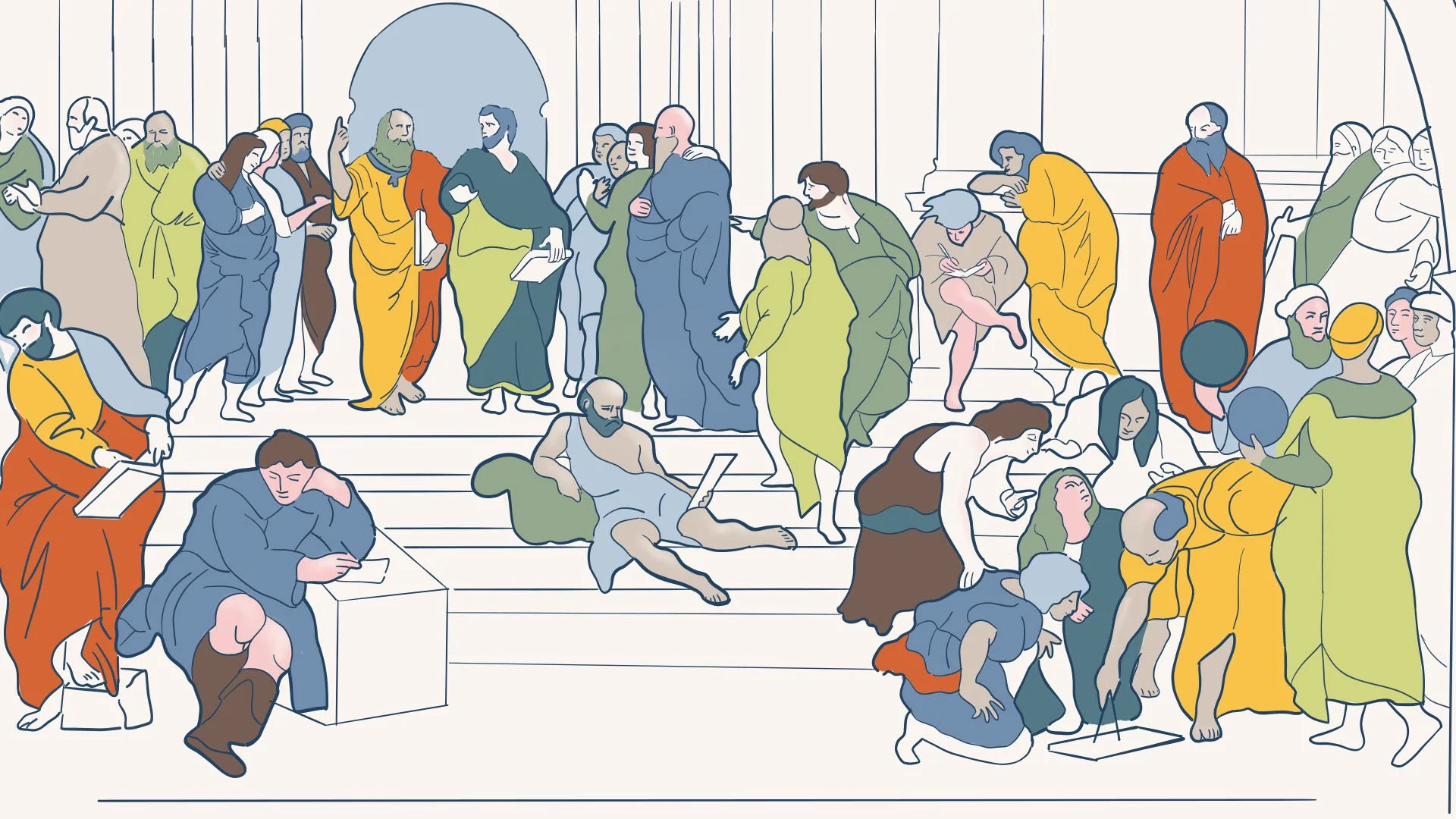
The School of Athens, Raphael, 1509–11. Vatican, Apostolic Palace. Fifty-eight thinkers. One room. Every single one of them disagreeing. Raphael painted this at the last moment the world felt this uncertain about its own tools — and it's been relevant ever since.
In 1509, Pope Julius II commissioned a young artist named Raphael to decorate a private library in the Vatican. What Raphael painted on one wall has never stopped being relevant.
The School of Athens is not a portrait of a room. It's a portrait of an argument. Fifty-eight figures including Plato, Aristotle, Euclid, Pythagoras and Diogenes, gathered in a grand imaginary hall, each doing something different with the same raw material: thought. Some are teaching. Some are challenging. Some are ignoring everyone else entirely, lost in their own logic. Plato points upward, toward the ideal. Aristotle gestures outward, toward the world as it is. Neither is wrong. That's the point.
Raphael painted this at the dawn of the High Renaissance; a period when the tools of human knowledge were expanding so fast that thinkers weren't sure what to do with them. The printing press was 50 years old. Ancient Greek texts were being rediscovered. The world was being remeasured. Into that disorientation, Raphael painted an image of what it looked like when brilliant people were in the same room together, thinking together, disagreeing productively.
We are living in a version of that moment right now.
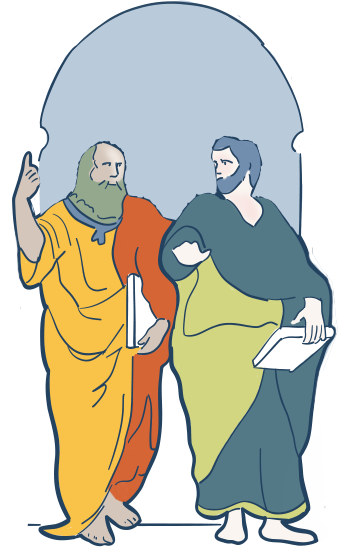
Detail: Plato (left, pointing upward) and Aristotle (right, gesturing outward). The idealist and the pragmatist, walking together. Raphael didn't choose a winner. Neither should we.
The room has changed. The question hasn't.
The arrival of capable AI - the kind that can write, reason, synthesize, generate, and respond - has produced the same split we see in that fresco. Some people are pointing up, toward the ideal: AI will free us from drudgery, accelerate discovery, democratize expertise. Others are gesturing outward, toward the practical: what does this mean for my work, my clients, my livelihood, my craft?
Both are right. And both are having the argument in the wrong frame.
The School of Athens isn't a painting about answers. It's a painting about what happens when you put people with different ways of knowing in the same space. The tension is the point. The diversity of approach; empirical and idealist, formal and intuitive is what makes the room generative.
The most important question about AI isn't "will it replace us?" It's the same question Raphael posed in 1509: what do we do when the tools for thinking get bigger than any one person?
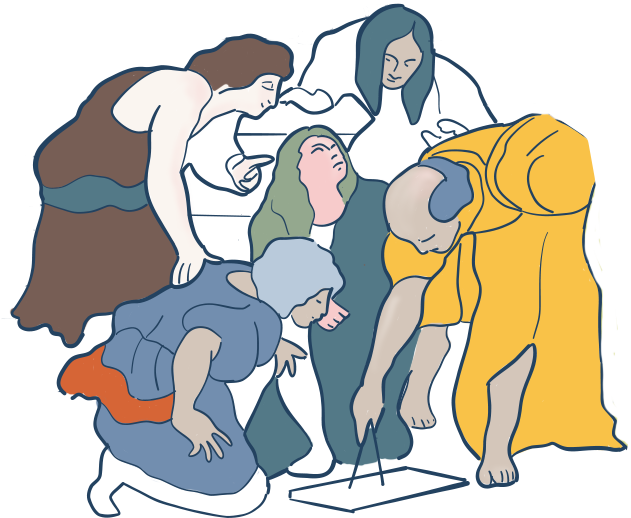
Detail: Euclid demonstrating geometry on a slate, compass in hand. The best minds in the room aren't performing expertise. They're still practicing it. Still bent over the work. Still willing to be corrected.
What the painting gets right about expertise
Look at the bottom-left corner of the fresco. Pythagoras is writing in a book while students crowd around him, trying to see. He's not performing knowledge; he's working, and they're watching. In the bottom-right, Euclid (painted to look like Raphael's mentor Bramante) is bent over a slate, compass in hand, demonstrating geometry to a small group.
Neither of them is at the center. The center belongs to Plato and Aristotle, walking together, mid-debate.
Raphael understood something that's hard to hold onto in a noisy moment: expertise is not a destination. It's a practice. The people who are best at their craft are almost always the ones still actively working it, still bent over the slate, still in dialogue, still willing to be wrong.
AI does not change this. If anything, it makes it more visible. The professionals who will thrive are not the ones who know the most facts; AI has those. They're the ones who know what to do with them. The ones who ask better questions. The ones who can hold Plato's idealism and Aristotle's pragmatism in the same hand and figure out which one the moment calls for.
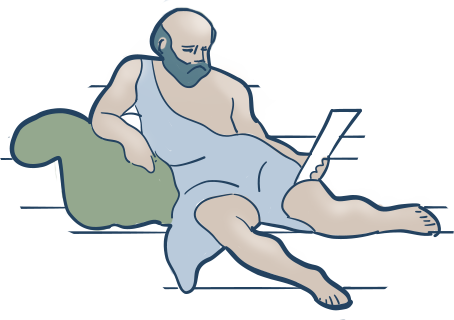
Detail: Diogenes, alone on the steps, apart from the gathering. Every technology wave has a Diogenes — the one who won't join the enthusiasm, who keeps asking: but what is this actually for?
The figure everyone forgets
Tucked in the lower-left, nearly out of frame, is Diogenes - the philosopher who famously lived in a barrel, rejected material comfort, and spent his days telling powerful people they were fooling themselves. In the fresco, he's sprawled on the steps alone, ignoring the entire gathering.
He's there as a challenge. A question. What if none of this matters? What if all of your tools and systems and frameworks are just a more elaborate version of the same old confusion?
Every technology cycle has a Diogenes: the person in the room who won't participate in the consensus enthusiasm, who keeps asking "but what is it actually for?" They're annoying. They're also usually right about something important.
The wisest approach to AI for leaders, designers, strategists, communicators, is to be Aristotle and Diogenes at the same time. Pragmatic enough to learn the tools. Skeptical enough to keep asking what they're actually for.

Detail: Raphael's self-portrait, looking directly at the viewer. Not teaching. Not arguing. Just present — and making eye contact. The most radical thing in the painting.
A painting about us
Here is the thing about The School of Athens that most people miss: Raphael put himself in it. He's in the bottom-right corner, looking directly at the viewer. Not teaching, not arguing, not demonstrating. Just watching. Present.
It's the most radical thing in the painting. The artist, inside the work, making eye contact, as if to say: I made this, and I'm still here, and what do you think?
That's the posture I'd argue for, in this moment. Not the breathless adoption of every new tool. Not the reflexive resistance either. Just: present, watching, thinking, asking what this is really for - and willing to put yourself in the frame.
The room is full of brilliant thinkers again. The question is whether we show up.